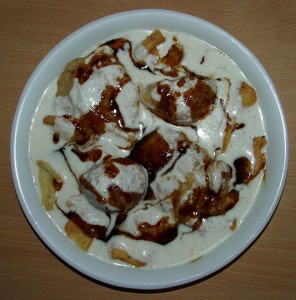
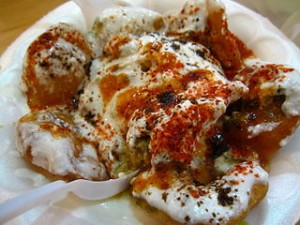
Various varieties of Chaat are some of most popular Indian street food dishes and quite more than just snacks for people in India. Chaat is among the lightest, cheapest and most convenient meal to have when someone is in a hurry. Indian street food is incomplete without a mention of chaat. A confusing point that many people don’t get is that a lot of Indian street food items are called chaat. Some of more popular chaat dishes are papdi chaat, gol gappa also called paani puri,and bhalla chaat. Chaat is a street food dish, but some kind of it always served during most parties in India. Even posh, high-end restaurants have started serving chaat items, but they are often beaten by the street food vendors who have been doing it for generations A large number of chaat food items exist in India, many with completely different flavours, looks and ingredients from the rest. Many chaats are eaten cool and thus are enjoyable even in summer. Pani puris for example, are just water flavoured with digestive spices served in hollow balls made of crisp flour. Sometimes they are garnished with chick peas and boiled mashed potatoes. The flavoured water is usually salty made using pudina (mint), rock salt, pepper, and some other ingredients depending upon where you eat it. For people who like sweetness, bit of sweet and tangy tamarind chutney is added. A number of different flavours among pani puris are available catering to almost every type of fan. The flavoured water is considered to help with digestion and is useful in preventing dehydration during hot summers of India. Many people drink pani puri water by cups.
Puris are the most common ingredients for other types of chaats. They are small, crisp and crackle loudly when broken. Boiled or fried potatoes and two or more types of chutney ( a type of sauce) are also used. One chutney, made of imli (tamarind) is sweet and tangy . Second one is spicy and made of pudina (mint), ginger and green chillies.
Many street food items, including chaat may or may not have dahi (curd, yooghurt), another popular food item in India. It helps with digestion and makes tolerating excess spiciness easy for people who are not used to it. Dahi bhalla chaat is a very popular and tasty street food item, specially popular during summers. The yoghurt is thickened and sometimes sweetened, giving it a smooth creamy texture which gels really well with bhalla . It is sometimes sprinkled with chaat masala, onion garnishing and bits of fried potatoes. Chaat masala is another thing which helps with digestion but is used more in a wa, not just to increase the flavours. It may have different varieties and ingredients in different places. Most popular are powders of , dried raw mango (aam choor), ginger, pepper, rock salt and dried pomegranates ( anaar daana). Apart from their use as chaat masala, these ingredients are also used in combination with other different ingredients as churan to help with digestion.
Bhel puri, from Maharashtra is a very tasty light snack made of sev ( thin noodle like crisps made of besan) and puffed rice. They are sprinkled with chaat masala, chutney and garnished with tomatoes and onions. It’s a good snack to have, light on stomach and low on oil.
Aaloo tikki is another very popular chaat dish made of boiled and then crisply fried potato cakes. They are served as soon as they are cooked, garnished with chaat masala, chutney and sometimes yoghurt. It’s a heavy dish due to fried potatoes but it’s popular all the same. McDonalds in India even launched a McAaloo Tikki burger to cash in on its popularity. Even if the chaat may seem heavy or tough to digest, yoghurt and chat masala make sure that your digestive system stays fit and healthy. As with everything else, it’s not good to eat chaat in excess, especially if you don’t know about Indian food in details
How to eat chaat or any other food in India
While traveling in Delhi or any other Indian city, you will find a number of street food vendors selling different varities of food with chaat vendors being a significant majority. Some of them will be there just to make a quick buck and be done with the whole thing, while others serve their food with pride and care for customers. Important thing is to know how to distinguish between the two. Good street food vendors care for their clientele and serve only the best quality food. You can tell it from their loyal customers.
Make sure that the food vendors you visit obey basic hygiene rules. Confirm that the food ingredients are covered and protected from dust and flies. Most street food vendors use disposable plates, but if they are not, make sure that they are clean. Read this article to know more about how to keep safe from water and food related problems while traveling.
We hope that this article will help you enjoy Indian street food, specially chaat better. Happy munching. Contact us for feedback, queries or for booking an Indian street food tour.
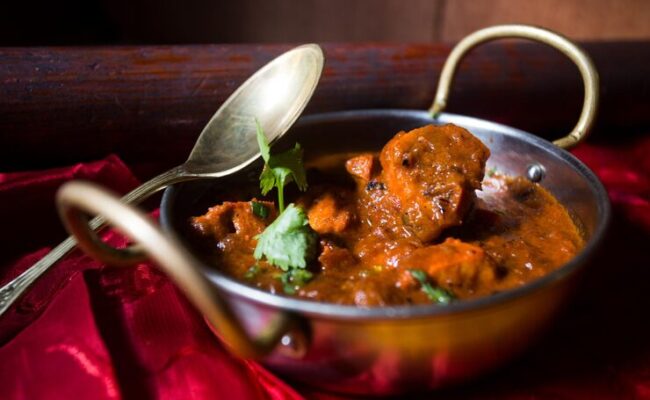
How to cook Mutton Curry In Tamil curry essentially means sauce. The curries are made from the combination of different types of spices along with yogurt or coconut milk. This combination will depend upon different regions of India. The curry is served either wet or dry depending upon the taste of people. They are made out of mutton, chicken, fish, prawns, eggs and vegetables. Requirements: Cubed 500 grams mutton Chopped onions 5 Ginger – garlic paste 1 tbsp made in 1 cup of water Chilli powder one a half teaspoon Green chilli paste 1 teaspoon Half cup tomato puree Coriander powder 1 tablespoon Turmeric powder half tablespoon Yoghurt 2 cups 8 black peppercorns and cloves 1 tsp – cumin seeds, 1 cup of coriander leaves neatly chopped Half of cup oil Salt to taste Cooking Methodology: Firstly flatten all the meat cubes into flat pieces. Now mix the yoghurt, chilli, turmeric, coriander powder and salt in the flat pieces of meat. Next step is to arrange half of the chopped onions in the pressure cooker at the bottom along with this arrange the pieces of meat along with yogurt mixture on the top of onions. Sprinkle ginger garlic water and rest of the onions then the whole spices Add 2 cups of hot water Pressure cook till done Now remove from the pressure cooker and cook until the gravy is thick. Once the gravy is thick add the tomato puree along with the oil Blend until the oil separates Garnish with coriander leaves and serve hot.
Tourism in India is a tale of amazing potential, confusing paradoxes, missed opportunities and massive under utilisation of resources. Compared to rest of the tourist hotspots around the world, India has mind boggling variety of tourist attractions of all types which can attract almost every single type of tourist out there. Ancient archaeological heritage of India which goes back to nearly 4000 years is spread all over India, from Laddakh to Kanyakumari. India is blessed with such awe inspiring ancient monuments at a scale unrivaled by any other country in the world. Forts of Rajput rulers in Rajasthan, artful temples of Bundels, luxurious monuments constructed by Mughals, amazingly beautiful Konkan temples are just a small fraction of this wealth spread across it’s length and breadth. Adventure tourists have some of the best and virtually untouched destinations in Laddakh, Himachal Pradesh, Uttranchal, Sikkim, Mizoram and other north-eastern states . Wild life enthusiasts have the option of seeing some of the rarest wildlife not found anywhere else in world in Gir, Jim Corbett and many other national parks. Adventure tourism, specially in north-eastern states has a lot of potential but hasn’t been explored even partially. The north-eastern states states have some of the best places for adventure activities like trekking, mountain climbing, camping and much more. Culinary tourism in India which has the biggest potential is just a small speck. Considering the vast culinary diversity of India, the country should be the top destination for all foodie tourists. So many religions like Hinduism, Sikhism, Jainism and Buddhism originated in India and their followers from all over the world wish to visit places important to their faiths. Medical tourism in India due to high quality healthcare at very low prices attracts people from all over the world. Culture and food junkies can’t find any place better than India with it’s diversity in languages, people, food, music, literature and culture which go back thousands of years. To top that, India is one of the cheapest tourist destinations compared to most of western countries. There is no other country in the world which offers so much diversity in such a package. Anyone would think that with so many blessings, India would be the tourist hub of the world. To top it all, India is one of the cheapest destinations in the world for tourists. In 2011, 62 lakh foreigner tourists arrived in India. Tourism sector in India employs nearly 4 crore people and is $ 121 billion dollar industry. Seems impressive, only till compared to 2.5 crore tourists per year Malaysia which has little to offer except beaches and and cheap shopping. Top tourist destination in world is France with 8.2 crore tourists in 2011 and 8.3 crore in 2012. India is not even in top 10 tourist destinations in world or even Asia. It’s actually ranked 38, preceded by countries like Saudi Arabia, Thailand, Egypt and even Tunisia. Just for sake of perspective, go through the following list: ( 1 million = 10 lakh, 100 lakh = 1 crore) Country No. of tourists Turkey 3.5 crore Morocco 92 lakh Tunisia 69 lakh South Africa 80 lakh China 5.8 crore Saudi Arab 1.7 crore Egypt 94 lakh Thailand 1.9 crore Looking at these figures, one can’t help but wonder what is wrong with Indian tourism sector. It’s not that people around the world are unaware of what India has to offer. Established travel forums like TripAdvisor and Lonely Planet are full of foreigners discussing and asking for information related to travel in India. Sections related to India are the ones with maximum number of posters. On Tripadvisor, India section has more than 10000 threads, exceeded only by 15000 threads of Thaliand. A lot people from all over the world wish to visit India but are turned away by numerous factors. Some of such issues are: 1) Complicated visa procedures: Infamous Indian red tape and bureaucracy is a nuisance outside the country too. Unlike other tourist hotspots, India makes it much more difficult and expensive for tourists to get a visa. India offers on arrival visa to only a handful of countries including Finland, Japan, Luxembourg, New Zealand and 4-5 others. In comparison, Malaysia offers on arrival visa to majority of countries except Israel, India, China and some African countries. 2) Bad infrastructure : Even though rapid development is happening, India is still a long way from having a world class tourist infrastructure. 3) Safety : Image of India has taken a severe beating recently due to various factors. Pakistan sponsored terrorism in various parts of India is also a big turn 0ff. 4) Lack Of Promotion Unlike other countries where governments and private organisations, spend large amounts of money and effort to promote tourism in their own countries, Indian efforts in this case have been very limited. Incredible India campaign which was launched with much fanfare a few years back ran out of steam pretty quickly. Above mentioned points are not unique to just India. A lot of countries face similar problems, have very little tourist attractions but still manage to attract many more tourists than India. We need to learn from them and make necessary changes as soon as possible. Some recent high profile projects like Golden Quadrilateral Highway project, Delhi Agra expressway, high speed trains with bio toilets etc are steps in right direction. But a lot more needs to be done. A lot of our customers are solo travelers, men and women of all ages. Some of them spend months or even years traveling inside India without facing any problem. But the recent bad press and selective reporting has messed up image of India badly. In an industry where perception counts for a lot, an effort has to be made to promote the attractions and good points of India rather than just the bad news. Development
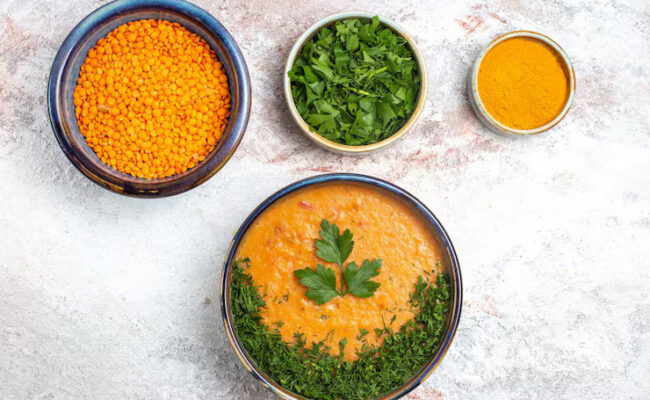
Moong Daal Recipe Lentils and grams are a very integral part of Indian cuisine. The daal is made in different ways from different areas and regions in India. One can make split green gram, Pigeon peas, green gram, Black gram and the list is vast. It’s not just delicious and but also very good for health. Ingredients: ½ cup split green gram (soaked for ½ an hour). Tomato – 1 no. ½ tsp. turmeric powder. ½ tsp. chilli powder. Coriander leaves. Green chilly -1 no. Salt as required. For the seasoning Garlic flakes – 3 . Oil as required. Cumin seeds – ½ tsp. Curry leaves – 6-7 leaves. Methodology:- Add the soaked dal with 2 glasses of water in a pressure cooker. Add one tomato, green chili, coriander leaves. Now add the masalas and salt. Pressure cook for 2-3 whistles. After the pressure has gone from the cooker take a heavy bottomed pot and add the ingredients for seasoning. When the cumin seeds start sputtering add it to the dal Serve with white rice and rotis.
India Food Tour: Social Media Posts, Aug 2022 Palak Corn with chapati Ingredients Spinach puree – ¾ cup Blanched and chopped spinach – ½ cup Boiled sweet corn kernels – 1 cup Ghee – ½ tbsp. Cumin seeds – ½ tsp. Ginger garlic paste – 2tsp. Chopped green chillies – 1 tsp. Fresh cream – 2 tbsp. Garam Masala – 1/4tsp. Chilli powder – 1/2tsp. Salt – to taste Serves: 3 Procedure In a kadhai heat ghee over medium flame, add cumin seeds. When it starts crackling then add ginger garlic paste and green chillies. Now add spinach puree, spinach, corn, salt, ¼ cup water, cream, garam masala, and chilli powder. Stir well and cook for 3 minutes. Serve hot with chapati or paratha. Photo Credit: https://cookpad.com/uk/recipes/4607449-corn-palak-sabji
Assam offers just the right kind of flavours to tickle your taste buds. With a wide variety of indigenous food to offer, Assamese food is famous for its distinct flavoring and influences. Delicious pork, chicken and mutton dishes are a must try. Baanhgaj or Lagot Kukura is essentially chicken cooked with bamboo shoots and lentil.The dish goes well with rice and it can be garnished with chopped green chillies and onions. Khaar is truly a unique Assamese preparation. Khaar is a heartwarming dish made with vegetables and pulses and the main ingredient being meat, fish or even duck. Even dried banana leaves which imparts burst of unexpected yet refreshing flavors. Lucchi is prepared by deep frying a roti made up of white flour, without making it crisp. It is served with a delicious potato curry. Lucchi is also known as Poori in other parts of the country. Masor Tenga is slow cooked fish with a broth made from outenga, tomatoes, and lemon and offers an extremely tangy refreshing flavour once done. Every Assamese definitely loves Masor Tenga. Payash is made using Joha rice and is loaded with ghee, dry fruits, and milk. Cooked on a low flame, one can also add cardamom and saffron for garnishing the dish. Overall, it is a must try dish for all those with a sweet tooth.
Indian Food Blog : Mizoram Mizoram food is mild in taste and is tinted with influences of Chinese cuisine. What makes Mizoram’s food special, is its traditional style of serving on the banana leaves. The food in Mizoram is prepared using mustard oil that gives a distinct flavour to the dishes, especially fish that is loved by the people in Mizoram. Bai is made of steamed vegetables along with pork, spinach and bamboo shoot, and spiced with local herbs. It’s mostly prepared with pork sauce (made out of pork and mustard). Bai is one of the most easily available dishes in Aizawl. Bamboo shoot fry is for all the vegetarian lovers. It has fried bamboo tossed with herbs along with shitake mushrooms and other vegetables .It is known as a light snack in Mizoram and generally enjoyed in the evening along with tea. Koat Pitha are deep fried fritters with rice flour and banana with the addition of fish. It has a crispy outer and a soft inner layer. It’s the best dish to pair with chai. Vawksa Rep is made with stir fried smoked pork with baby spinach and oyster mushrooms along with crushed garlic, ginger, green chilli and pepper. This dry dish is a popular dish in Mizoram that is eaten with steamed or sticky rice.
When it comes to food, Maharashtra will never disappoint you. From the world famous pav bhaji to the delicious bhelpuri, Maharashtra has a lot to offer to food lovers. It is food heaven for both vegetarians and non vegetarians alike. Basundi is a sweet dish made in Maharashtra. It is condensed by boiling the sweetened milk on low heat which gives it a nice flavour. Sugar, cardamom or saffron is added to augment the flavour and texture. Different types of basundi are custard apple basundi and angoor basundi. Bhelpuri is a savoury snack common in Maharashtra.It is a mixture of puffed rice, chopped onions,chopped tomatoes,tamarind chutney. Bhelpuri can be served in a lot of ways, but usually it is served on a paper which is folded in the form of a cone and is consumed using a paper spoon. Misal pav has a spicy and tangy lentil curry which is made with moth beans and is served with Pav bread. At times, it is eaten with yoghurt to lessen the spice.It is decorated with a slice of Lemon and Onion Coriander sprinkled on it. This street food is readily available at any street food joint and served hot. Modak is extensively eaten during the Ganesh Chaturthi Festival all around the state. The sweet filling is made up of fresh-grated coconut and jaggery, while the soft shell is made from rice flour, or wheat flour mixed with maida flour. The dumpling can be fried or steamed. Pav Bhaji is one of the spiciest, vegetarian dish. It is a mixture of boiled vegetables along with a lot of Spices and Onion Coriander mixture for garnish.Fresh and thick slices of bread, smothered in butter served with a delicious mix of moderately spiced vegetables. Vada Pav is the most favorite snack in Maharashtra.It is Potato Bhaji ball dipped in Besan Flour and fried in hot oil. It is stuffed in Pav with Garlic Chutney and fried Chilli. VadaPav is super delicious when served hot- hot spicy and slight crunchiness. It is also known as ‘INDIAN BURGER’.
Recipe of Parantha One of the most famous dishes in North India is parantha which is loved by most of the people. When you will visit North India, you will find parantha streets everywhere around the region. This is a very popular dish which is highly popular worldwide and people from all over the world come here to enjoy it. To bring in the taste of the typical North Indian parantha, this dish is been prepared under a special process. One has to make arrangements for firewood with burning coal so that the parantha can get a smoky flavor. One can even use a griddle to prepare parantha at home. Now follow the ingredients to make this recipe: You will needs around 2 cups of wheat flour Around 2 spoons of ghee Around 1 spoon of chilli powder Water as per requirement Salt as per taste Utensils: Rolling board to make the parantha Rolling pin Method: Now mix all the ingredients given above with water to make soft dough. Leave the dough for 10 minutes. Prepare three to four balls of the dough for later use. Place the dough ball on the rolling platform and roll on it. Now apply some ghee on top of it. Fold it in a shape of a crescent and apply ghee and fold it in a triangle shape. With the help of rolling pin, roll the dough into triangle or circle. Now fry with ghee on tava and eat it with your favorite side dish.
We use cookies to optimize your experience, analyze traffic, and personalize ads. Please choose whether you accept our use of non-essential cookies.
Read More
Cookies are small text files that can be used by websites to make a user\'s experience more efficient. The law states that we can store cookies on your device if they are strictly necessary for the operation of this site. For all other types of cookies we need your permission. This site uses different types of cookies. Some cookies are placed by third party services that appear on our pages.
Necessary cookies help make a website usable by enabling basic functions like page navigation and access to secure areas of the website. The website cannot function properly without these cookies.
Marketing cookies are used to track visitors across websites. The intention is to display ads that are relevant and engaging for the individual user and thereby more valuable for publishers and third party advertisers.
Preference cookies enable a website to remember information that changes the way the website behaves or looks, like your preferred language or the region that you are in.